
The guide has to belong here.
A character notices you. The trick is making that moment feel connected to the street beneath your feet.
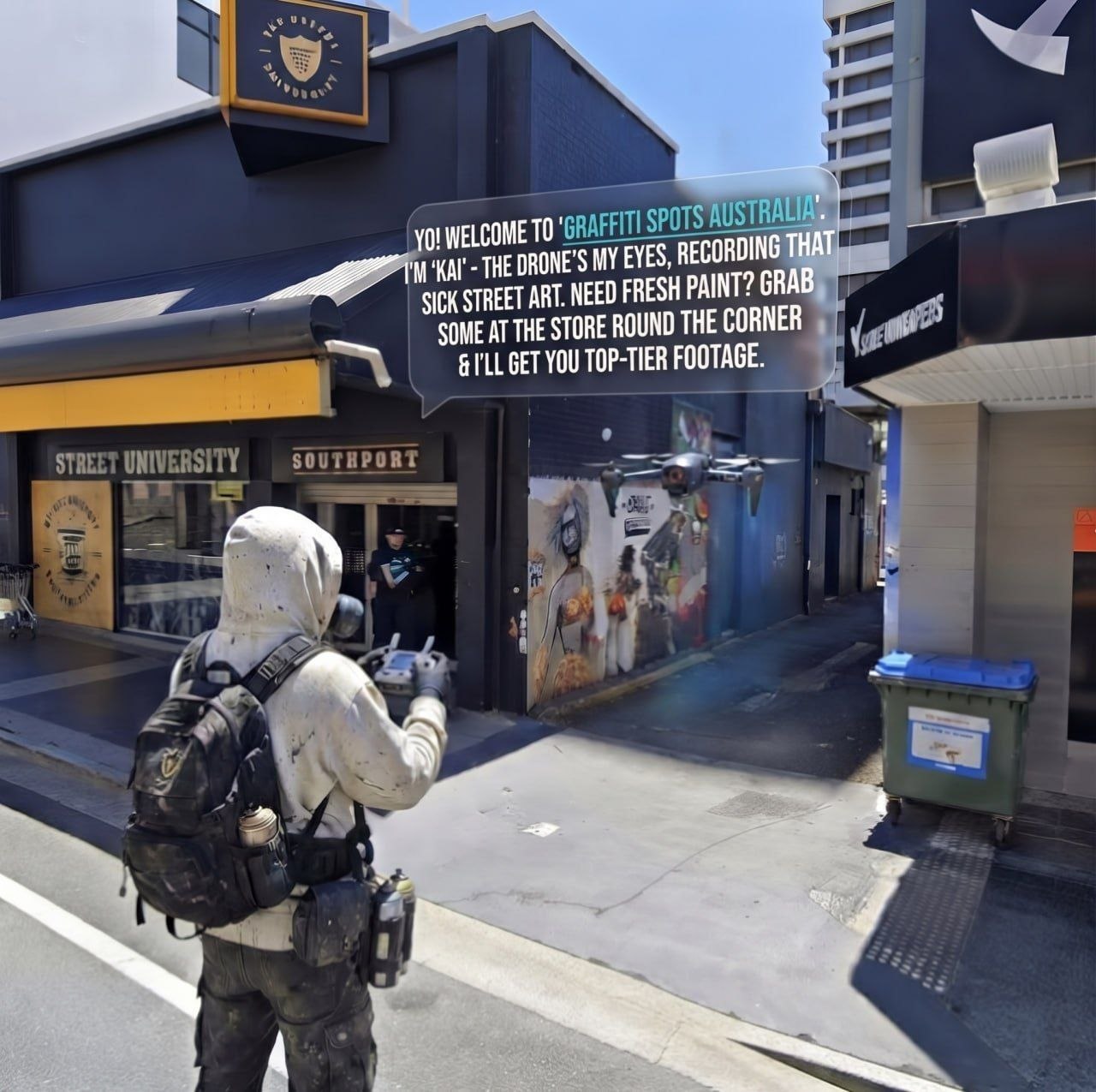
Inside the build · concepts and current progressYou’re walking towards a wall. Someone is busy with a controller. He looks up when you get close. No dramatic cutscene announcing itself. Just a moment that seems to have been waiting there.
That is the first encounter we are trying to get right. The masked operator and drone give you a way into the game’s fictional world. But their performance is only half the job. If the character slides with your phone or greets you again every time you shuffle, the moment falls apart.
Finding the place and placing the person are different jobs.
The map helps you choose a destination. Inside AR, tracking estimates the camera’s position and orientation relative to a local scene. An anchor gives virtual content a reference within that scene. A map coordinate alone cannot tell the app which way a particular wall faces.
Google’s anchor guidance also makes a useful distinction: nearby objects can share an anchor so they maintain their relationship as tracking updates. Separately anchored objects may adjust independently. For a character and their equipment, belonging together is part of the illusion.
A greeting needs memory.
A proximity reaction is more than a timer. The app needs a valid distance, a state that says whether the introduction has already started, and a way to stop speech cleanly when you leave or background the app. A slightly wider leave threshold than approach threshold prevents small movements near the boundary from becoming repeated arrivals.
That supports the performance we want: he notices you, offers something, and waits for your decision. Accepting a challenge should be an intentional action. Walking past a character should not quietly sign you up.
Recognition gives the mission a reason.
The creative direction borrows the feeling of the skate games we grew up with: make something, get a photograph, become known for your work. Fictional magazine invitations can give progression a story. They are not promises of real press, sponsorship or paid commissions.
A good first mission should teach that language without making you read a manual: meet the guide, understand the offer, capture what you made, and keep something that remembers it. Later characters can complicate the story once that first handoff works.
Find the place
The map gets you nearby. A location coordinate is a starting point; it does not establish the face of a wall, a safe entrance or a deployed AR anchor.
Read the sources.
External sources explain the underlying methods. They do not verify this app’s implementation.